FEIT Cultural Collection at Melbourne Connect
The FEIT Cultural Collection stretches back to the commencement of the teaching of engineering at the University.
The opening of Melbourne Connect in late 2020 will create new opportunities for research and collaboration in MSE, however it will also encourage us to celebrate and reflect upon past and current achievements.
The FEIT building at Melbourne Connect will include 16 showcases and displays, integrated into the main circulation spaces and active hubs across the seven floors. It is envisaged that each unit and its surrounding environment will act as a portal to drive the exchange of ideas, knowledge, skills and vision for technological innovation. Walkways should become key moments for wonder, celebration and collaborative engagement.
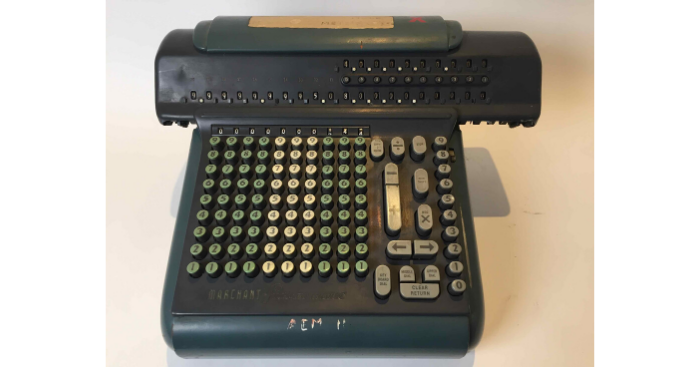
Electromechanical calculator, Marchant Figurematic, 1954. From an era when ‘computers’ referred to the staff (often women) who performed complex and time-consuming calculations.
The displays at Melbourne Connect will showcase MSE’s history of teaching, research and collaboration with industry and community partners. The displays will explore the diverse ways in which FEIT has contributed to society by tackling key social, environmental and technical challenges.
The displays will comprise a designed mixture of artefacts, documents, images and media. Tablet screens can present existing or commissioned captioned videos and images. Wherever possible, the videos, graphics and text will feature the personal stories of researchers and end-users, so that there is a strong sense of FEIT working in its many and diverse communities.

Tellurometer microwave distance measuring instrument, 1962, which transformed the precision surveying and mapping of Australia.
History of the FEIT Cultural Collections
The collection stretches back to the commencement of the teaching of engineering at the University. Two transit telescopes dating from the 1850s were used by Professor William Wilson, the founder of the engineering course, to teach astronomy and surveying in the 1860s and 1870s. A set of German kinematic models was acquired by Professor William Kernot from the 1880 Melbourne International Exhibition, and used to demonstrate mechanical principles to his students. Also surviving are a number of instruments and electrical standards acquired by Edward Brown to establish the course in electrical engineering in 1911.
Most of the existing collection has been developed within individual departments. At present there are four collections formally recognised as part of the University of Melbourne’s Cultural Collections:
- Computing & Information Systems Collection
- Electrical & Electronic Engineering Collection
- Surveying & Geomatic Engineering Collection
- A.G.M. Michell Engineering Collection

Magnetic core memory unit from the University’s IBM 7044 mainframe computer in 1974: all 16 Kb of it.
Smaller collections and highly significant items are also held by departments and teams across MSE, and these are now being documented. The entire FEIT cultural collection is currently being combined into a single coherent collection. Creating a unified FEIT Cultural Collection will facilitate a strategic and holistic approach to the collections and their use in displays, object-based learning, online access, and advancement activities.

Apple Macintosh computer, 1984. Early computer labs were fitted out with networked Macs, and thousands sold to staff and students.
Contemporary Collecting
As well as displaying historic material, the displays are intended to showcase and celebrate current research and collaboration. This requires a program of targeted collecting and documentation with research teams and industry partners. An initial program of acquisitions includes:
- An Indigenous artistic commission to reflect traditional and current cultural and aquaculture practices at Budj Bim.
- Recent and current projects in biomedical engineering: eg Stentrode, epilepsy monitoring, personalised 3D body prostheses, bionic eye, tissue engineering.
- Current Interaction Design Lab projects.
- The Australian Integrated Multimodal EcoSystem (AIMES) project.
- Student satellites: Australis OSCAR 5 (1970) and CubeSat of Melbourne Space Program (2019).
- Fishermans Bend Digital Twin.
- Computer modelling and visualisation of turbulence
- Petascale Campus Initiative
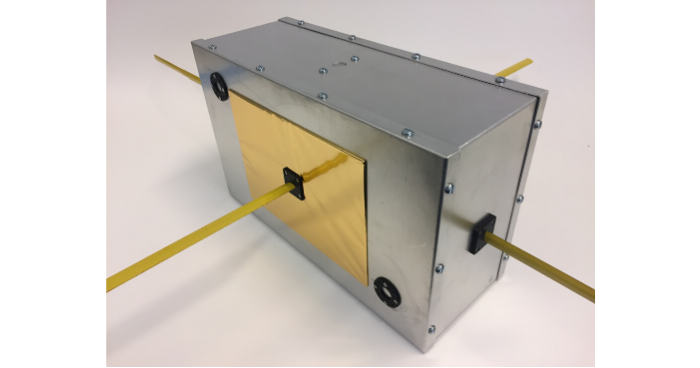
Replica of Australis OSCAR-5 satellite, designed and built by University of Melbourne students in 1968 and launched by NASA in January 1970.
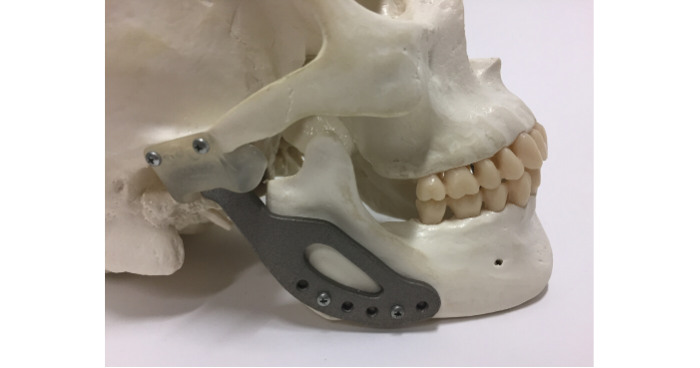
Personalised 3D printed prosthesis of temporomandibular joint, 2017. Dr David Ackland led an interdisciplinary team in Biomedical Engineering and St Vincent’s Hospital.
Dynamic Displays and Information
Changeover of content and new stories are essential to keep the displays fresh and engaging. Staff and students will be encouraged to contribute, showcasing their current research and collaborative projects. Other displays of iconic items, such as the original Computation Laboratory door (1955) and the IBM 7044 computer console (1964), will remain for longer periods, and serve as signposts for their respective work areas.
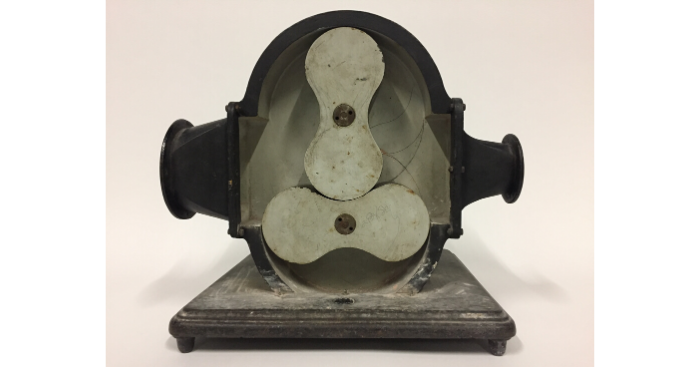
Teaching model of a Root’s Blower, made by Carl Schroeder, Germany and purchased by Professor William Kernot from the Melbourne International Exhibition, 1880.
The displays will be supported by a new database encompassing all the FEIT cultural collections. The database will support catalogue entries for individual items (artefacts, images and media), but also related records for individuals, organisations and historical narratives. An online version of the database will also enable offsite access to the information, and crowd-sourcing of information and stories from staff, alumni and collaborators. The database will facilitate object-based learning using the FEIT cultural collections, with the ability for students to add information and interpretations to the collection.
Through displays at Melbourne Connect and the new database, the FEIT cultural collections will be brought in the present, and help us shape the future.